Latent Alter-Portraits
I will put my Spirit in you and you will live. I will attach tendons to you and make flesh come upon you and cover you with skin; I will put breath in you, and you will come to life.
The Valley of Dry Bones.Ezekiel 37
When my friend P. P. M. wrote the headline for the catalogue of the exhibition Interior Ulterior: «Martín Sampedro: The New Photography», I was surprised by his ability to explain my work as a pioneer of anew event. The New Photography, in which I work, is not made of the daily moments which Pablo used to call “my own life”, but incorporates other lights, other life forms, hallucinations or virtual beings, as essential elements of the photography. Naming my work this way, he acquitted the taboo of the dangerousfriendship between traditional photography and the new forms of creating images in the digital era. That’s where the inverted “N” comes from: in memoryofthe magazine “Иueva Lente”, of Pablo Pérez Mínguez, Carlos Serrano and Jorge Rueda. Their recognition and example are within me when I create images and look for a way to name them; new photography, fantastic photography, magical realism or grotesque beings, in memory of my neighbour Valle-Inclán.
Could I live life without thinking about it, observing it, photographing it, naming it?
Since I can remember, spending time taking pictures has helped me to revealintuitions. As much as words can dress up an idea, photographyhelps me undress the reality. What I think is condemned to be forgotten. As I write, I forget, but images are what stay latent in my memory. When I think of a concept, for example love, inevitably it brings to me the image of people I love.Memories, concepts and feelings have the appearance of a photograph, even without the intervention of a camera, or withoutpressing the camera shutter to catch the instant. What we think we do consciously, is made by our mind unconsciously, naturally, without any camera, developing or retouches. The subjective camera is always turned on, working in raw to show us something that is not merelyretinal; from which springsmy impure vocation to cook images, to push subjectivity to the limit.
But what happens with blind people? Don’t they cook images too?
I close my eyes to ponder this question and I see some coloured spots, energies and forms that I can’t reach… I feel my eyes blinking like a film reel, almost electric, maybe it’s the echo of the fluids beating inside of me. My jaw relaxes and starts shivering, it vibrates, jingles as if I was nervous… That’s not what I expected! I forgot to bleed the radiators and maybe the cold is shedding light on this mystery. In every grind of my teeth, flashes of holographic images pop up, weaving memories and wishes…,my eyes inundated by the emotion.
With my eyes closed, I have seen portraits and fragments of reality that take me back to my childhood, nothing strange but vertiginous. Wow! When I dress in the skin of a blind person, I hallucinate and cry as hewould do if his sight had been restored.
Is photography anything but hallucination?
After Interior Ulterior, La extrañeza de Existirand Sangre Azul, in which the human figure had been replaced by virtual beings, with the excuse of showing the different dimensions of existence, I find myself doubting whether to continue on this path. When closing my eyes to visualise the dimension of the disaster, I discover how abysmal it is to walk alone, and how lucky I am to have so many invisible friends. Those grotesque beingsthat guide me and make my work so recognisable are giving me the chance to create myown imagery.
Unwittingly they seem to provoke a conflict between the human world and traditional photography, which I would never reject, as it has been with me since childhood, saving me an infinite amount of empty words. “Latent” was that magical sensation that enlightened my imagination as opposedto the reality caught in the film rolls that hung from the shower. “Latent” is the rush to sense the miracle of life, the vital energy. “Latent” is the light that I reclaim, the light from your gaze; “You’ve come, Telemachus, you sweet light”..This sweet light Homer named in Greek as (phaos/phaeo), instead of the sunlight(phos/photos), which gavephoto-graphyits name. That was the light that lit the latent, and that’s why at some point I called my photographs: “phao-graphs”.
Thepassion humans have to imitate what occurs in nature has always caught my attention. A freshener that smells of pine, a painting that looks like a landscape, a photographthat looks like a painting, adrawing so well done that is almost real … Everything around us inspires us to deconstruct and manufacture as if we were creators. The economy, the development, the welfare, the discomfort, everything humans do revolves around the possibility to ownthat which in nature is given for free.
But we accompanyit with a white lie, a price, sometimes a death trap. We also elaborate creations and trompe l’oeilwith which we show the latent dimension of that we admire. So art, in this digital age, is visited, revisited, copied, duplicated, imitated, fondled, improved, valued, devalued, sent, stolen and given away, with the urge to postpone rather than to propose. Perhaps by triggering the shutter of a photographic camera we consciously decide to catch something memorable and preserve it as something true. However, the truth is latent, and the creation isan invention.
Will there be a new art, beyond entertainmentorshow?
I’d like this last experiment, Latente, to say something in favour of the New Photography and itsspiritual light. At last we can photograph the nonexistent,we can raise the eyesbeyond the obvious and build a reality without fear of collapse. When looking at the Latent collection of photos, after the contemplation, theonanism or aesthetic delight, I feel that to breathe, to move,to photograph and to share places or nonexistent people, respond to my necessity to meetmy Alter-ego. And to make myself understood, I have coined a new word loaded with future that describes what I do now: “Alter-portraits”.
Since Louis Dodero invented the famous calling cards with which photography became popular in the early days, the camera has seen constant innovations that have transformed the way we see and understand life. The digital revolution has only just begun. The massive development of this technology has enabled anyone to express themselves and create portraits in the easiest possible way. Soon digital cameras will be equipped with new spatial and sensory technologies that capture, represent and share what you see when you close your eyes.
So loosen your eyelids and let rise the latent. I offer this collection of alter-portraits as a homage to photography and the photographers, those of the negative, the positive, the microscope, the endoscope, the scanner, the 3D and the MRI; those of the latent hallucination, thosewho invented modern art and those who revolutionized the medicine and science based on new ways of looking at life and its different dimensionsand to the strength of their imagination.
Make this images yours, rebel, discover the magical feeling of revealing the latent, create new riddles and perhaps they can inspire and raise the dead.
Martín Sampedro, 14 de abril de 2015
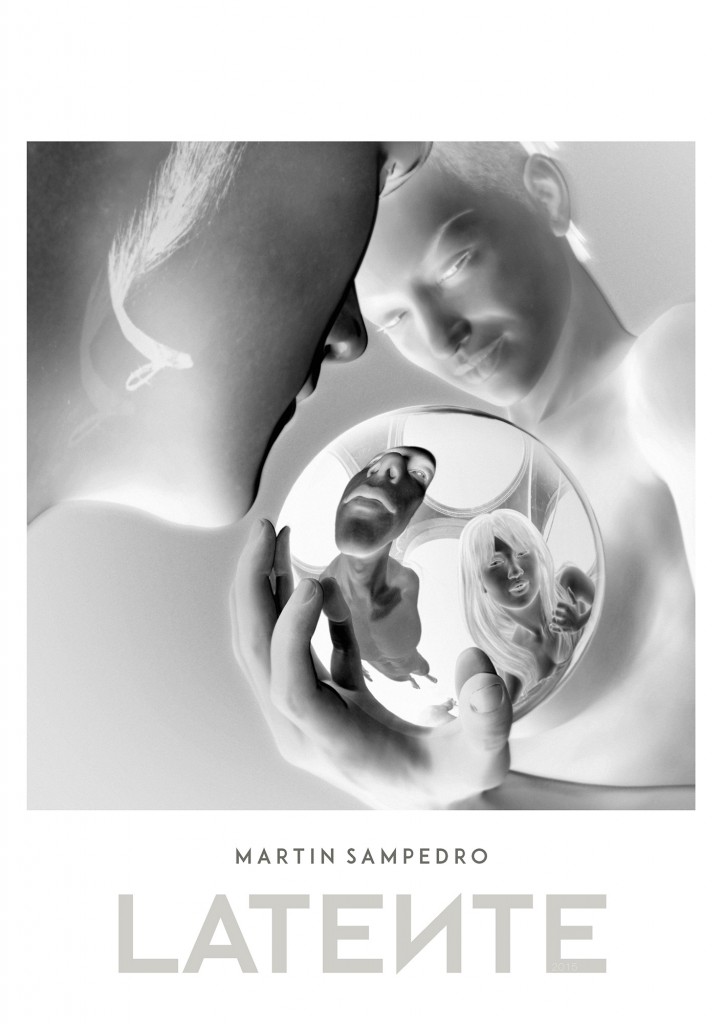
The “LATENTE” collection is shown in negative so that the viewer develops the photographic process. Through the camera of your mobile phone, you can see positive images. Use the camera by default from your smart phone, with the negative effect, or install a free application for iPhone.
[sgmb id=”1″ customimageurl=”https://www.martinsampedro.com/wp-content/uploads/2015/10/miniatura-latente-alterretratos.jpg” ]
Latente is a post-photographic project inviting viewers to discover the latency of images comprised within the series of Alter-portraits.
Sampedro’s “New Photography” incorporates latent lights and life forms, hallucinations and virtual beings, to question the nature of photography today in its relation to new forms of creating images in the digital era. Inspired by Valle-Inclán, whose portrayal of figures from Spain’s political history often appealed to obscenities, ruthlessness and vulgar imagery as a means to mock the theatrical insipidity, Sampedro’s images of desire and sexuality are politically subversive and challenge the nature of photography. It would be hard to give a definition to what “New Photography” means since this is mostly a personal relationship with the photograph itself. Whether new photography, fantastic photography or magical realism, Sampedro’s work is based on a complex imagery and drastic perspectives on life that encourages an intuitive approach. “As much as words can dress up an idea,” says the artist, “photography helps me undress the reality.”
The idea of latency is thus a means to address and access the memorial qualities of an image rather than an elaborate structure of concepts that would have to do with an explicit thinking about images. “Memories, concepts and feelings have the appearance of a photography, even without the intervention of a camera or without pressing the camera shutter to catch the instant. What we think we do consciously, is made by our mind unconsciously, naturally, without any camera, developing or retouches. The subjective camera is always turned on, working in raw to show us something that is not merely retinal,” says the artist.
Sampedro’s manifest desire to push subjectivity to the limit allows him to create intuitive scenarios around the desire behind the image. These are not ‘negatives’ of the real; they reflect a different light altogether. In this sense, they are not portraits but rather the Alter-portraits of an alternate reality we are invited to discover beyond the naked visuality. While photography is a process of finding new means to reflect light across the opacity of matter, Sampedro’s images are meant to go through matter and desire, beyond what the camera records. Seeing through and into ourselves, the artist’s work is not radiographic either; it is a mental state that creates tension between our perception of the image and the reality we imagine around the given image. Sampedro’s latent photographs address the obscure nature of the psyche and disclose an illuminating process that is both technical and mental. It should come as no surprise then, that the artist’s insists on sexual imagery to seduce the viewer into his work. This has more to do with the energies and forms one cannot reach but longs for; the flickering and pulsating images in his video are a vibrating reel of imagination rather than reality. These “flashes of holographic images pop up” and weave memories and wishes together. They are visual vertigines rather than images as such.
Is photography anything but hallucination? (Martin Sampedro)
In envisioning the virtual being, the artist breaks away from the constraints of figuration, allowing the virtual camera to travel inside the body and across the fleshy planes as a means to explore the different dimensions of existence. The idea of latency is as much about the vital energy of matter, as it is about the germinal nature of the image itself. This, as Sampedro explains, might have to do with a distinction between phos/photos, the sunlight which gave photography its name, and phaos/phaeo, the sweet light in Homer’s envisioning of Telemachus. “That was the light that lit the latent,” says the artist, “and that’s why at some point I called my photographs: phao-graphs.” It is not a visual field that Sampedro seeks to reveal, but rather the consistency of matter as a matter of unconscious illumination. In a world that inspires us to deconstruct and manufacture, arising demiurgical pretensions over nature and the real, the artist’s gesture is meant to reclaim a certain spirituality. In this digital age, says Sampedro, “art is visited, revisited, copied, duplicated, imitated, fondled, improved, valued, devalued, sent, stolen and given away, with the urge to postpone rather than to propose. Perhaps by triggering the shutter of a photographic camera we consciously decide to catch something memorable and preserve it as something true. However, the truth is latent and the creation is an invention. I’d like this latest experiment, Latente, to say something in favour of the New Photography and its spiritual light. At last we can photograph the nonexistent, we can raise the eyes beyond the obvious and build a reality without fear of collapse.”
As we are ever closer to a moment when sensory technologies will allow us to capture, represent and share what we see when we close our eyes, Latency can be seen as a double artistic gesture: on the one hand, the artist invites to a dialogue between the possibilities offered by post-photographic media and the negative, the positive, the microscopic, the endoscopic, the scanner, the 3D and the MRI. These, as we know, have been instrumental in grounding modern art and inspiring the development of medicine and science. On the other hand, Sampedro’s Alter-Portraits confront the viewer not with an image of the other, but with an image of ourselves: our Alter-egos, our hidden desires, our intimacies, our thoughts and cravings, our very own eagerness. The latency of the image is, in fact, an appetency for our own selves. One can fall into the abysmal psyche of self-imagining and self-representations, a looping echology where one only apprehends himself and therefore nothing – or find new ways of looking at reality and the other, ways that are illuminated from the inside.
– Sabin Bors, October 12, 2015


 50 fotografías con historia se presentó el jueves 26 de octubre de 2017 en Madrid con la presencia de José María Díaz-Maroto, director de la Escuela Internacional PIC.A PHotoEspaña, reputado fotógrafo y comisario de exposiciones nacionales e internacionales, encargado de la selección de fotógrafos y obras presentes en el libro, y de Félix Fuentes, especialista en diseño editorial con una amplia trayectoria en proyectos vinculados al arte, que ha realizado la labor de redacción de textos y diseño editorial.